AYFKM? AI and 1% Commitment
AI is going to fuck up the workforce. Sal Khan (of the Khan Academy) is not offering a serious response to this tectonic shift.


This afternoon, I was browsing the NY Times when I stumbled upon this steaming pile of dung, a guest post by Sal Khan of Khan Academies.
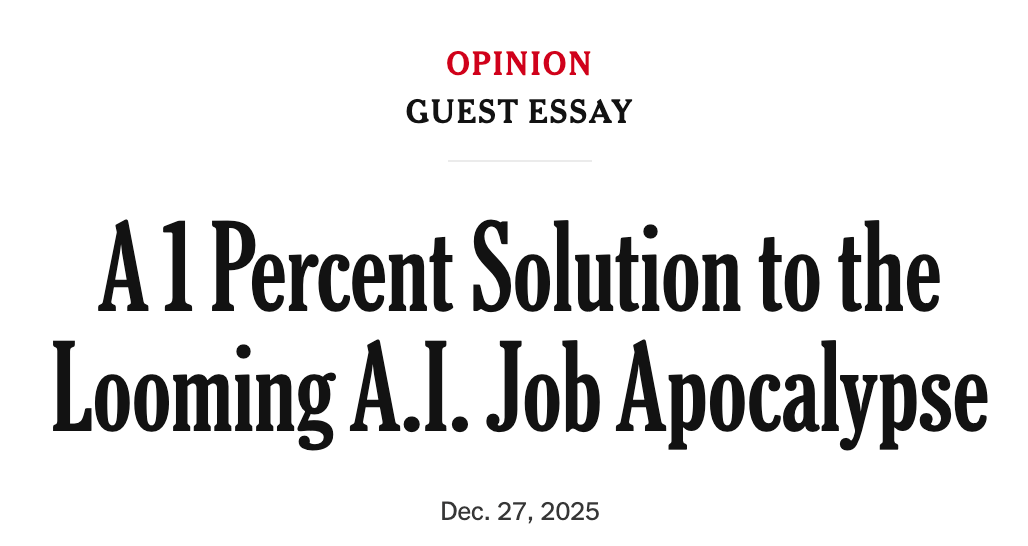
He starts about a recent trip thru Silicon Valley, and a conversation he had with an executive who operates call centers in the Phillipines. He had just replaced 80% of the staff on the ground with AI, a harbinger of what AI is going to do to a lot of employment.
My friend told me that a huge call center in the Philippines — a center his venture capital firm had invested in — had just deployed A.I. agents capable of replacing 80 percent of its work force. The tone in his voice wasn’t triumphant. It was filled with deep discomfort. He knew that thousands of workers depended on those jobs to pay for food, rent and medicine. But they were disappearing overnight. Even worse, over the next few years this could happen across the entire Filipino call center industry, which directly makes up 7 percent to 10 percent of the nation’s G.D.P.
I guess the hollowing out of the call centers in the US, shipping them to the Phillipines was A-OK, but now the 3rd world outsourced jobs are being affected and this executive is worried about these people's livelihoods...[1]
Anyhow, this causes Khan to muse that the AI revolution is going to be a fucking nightmare for workers.
No shit, Sherlock.
When I first glanced at this the name "Sal Khan" didn't click, then when I dove into the comments it became clear that this was the founder of the Khan Academies, producers of online courseware that is increasingly used to augment school curricula.
Fine. No, really fine. I work in adult education, so I know a tad about what I speaketh.
Khan then reveals that his friend, who's turfing 80% of his Filipino call center workers has committed 1% of his profits to help retrain these people:
Because of this, my friend has decided to commit 1 percent of his firm’s profits to help people learn new skills for jobs, demonstrating what leadership looks like in the A.I. age. I believe that every company benefiting from automation — which is most American companies — should follow this lead and dedicate 1 percent of its profits to help retrain the people who are being displaced.
Gee, that seems generous.
NOT.
Look, the disruption and dislocation in knowledge work in particular, but it is also is going to impact other work. Khan mentions the rise of Uber and Lyft that decimated the medallioned cab drivers. And he leads off the piece with the whizzing around of Waymo autonomous cabs in San Francisco.
Note: A lot of working men are in the transport and delivery business. Driving cabs, delivering for UPS/FedEx, and doing long haul trucking. These are all jobs that don't require college degrees, or other credentials. Good, solid blue collar work. AI is not going to skip over these people. That will be additional stress on the "lost men" that I hear conservatives and manosphere podcasters opine on.
Anyhow, Khan generalizes his friend's "generous" commitment to helping fund retraining with 1% of his business' profits to fund retraining, and says he will work to get a similar commitment from other business leaders.
One fucking percent. Not of "revenue". No, of profit. To fund retraining of literally millions of people.
For someone in education, he is pretty clueless as to what it takes to re-educate people. Perhaps it is because he's been building education material targeting teenagers, as a non-profit (that is a cool thing, not dissing him) he thinks that it will be trivial in both cost, and execution to "ease" the displaced workers into alternative careers.
But this is unlikely. Highly unlikely to work.
First, a lot of people seem to think that just "upskilling" people will let them slide back into a white collar or knowledge work role. The fact is that AI is taking these jobs.[2]
Second, it is expensive to do this. There have been hundreds of billions of taxpayer dollars that have been spent to help displaced workers through the 80's and 90's when offshoring was big. Hell, a lot of those call center jobs that were moved to the Phillipines triggered re-training efforts. And that was an easier lift. At that time, there was still growing roles of tech workers. Now? There ain't a lot of hope.
I am not even going to mention the 1%. These "owner" class fuckers got massive tax breaks in the last two and a half administrations (Biden didn't undo any of the fuckery of Trump I), far more than that pissant 1% pledge.
This is like pissing on a volcano that is erupting and claiming you're doing something.
The Real Deal
The problem is that business leaders aren't really looking to upskill their people for the AI age. Instead, they are licking their chops to de-skill roles.
That is, to remove the need for highly skilled mid and late career people, people who know how to do the job. They are planning to hire lower skilled people (for less $$$) and use these new-fangled AI tools to make them productive.
They don't want to enable their staff to be more efficient. They want to replace as many expensive people as they can with junior people, couple them with custom built AI tools, and make more profit.
Khan's deception
While I do not work for the Khan Academy, I am in the biz to make technical training. I would bet my bottom dollar that the Khan Academy is using the AI tools available today to cut human labor out of the loop in building the curricula they offer. AI can build outlines, do the instructional design, create scripts, build story boards, build graphics and simple automation, and package it ready to post to Google's educational platforms that it seems they rely on (Google Classroom).
While Khan Academy is a non-profit, they will not be on the hook for his 1% pledge, he has to know that 1% is a drop in the ocean.
The future is going to be bad. We are going to have to restructure the economy, institute a UBI, streamline the creation of unions, and take a serious whack at addressing the income inequality that really began early in the Reagan administration. The bulk of Americans have been left long behind.
1 - I worked at a company in Tucson, Arizona that was in a former IBM call center, and the second company I worked at there still had a small call center in town. Call centers were central to the economy in the 80's and 90's but by the time I landed there in 2003, it was largely gone.
2 - The wave of tech and knowledge jobs, that drove 20+ years of prosperity, a lot of STEM and CompSci degrees, is going away, replaced by far fewer jobs, and the skills that are needed will not be easy for techies to acquire. Critical thinking, strong communications skills, and a breadth of knowledge over deep technical skills will rule.